
BARKSDALE AIR FORCE BASE has a unique calling and tremendous responsibility for the critical mission of our nation to provide strategic deterrence, both nuclear and conventional.
Barksdale Air Force Base is a critical element of the nation’s strategic deterrence, nuclear operations, and long-range strike forces. The base is home to Air Force Global Strike Command, the “Mighty Eighth” 8th Air Force, Joint Global Strike Operations Center, the 2nd Bomb Wing, and its Air Force Reserve partner, the 307th Bomb Wing.
Air Force Global Strike Bomber, Missile, and Command and Control Wings across the country:
Population:
Active Duty Members
Reservists
Civilian Employees
(Appropriated, Non-Appropriated/Contract)
Military Family Members
living within a 50 mile radius of the base.
Military $478 Million & Civilian $175.8 Million
In Economic Impact
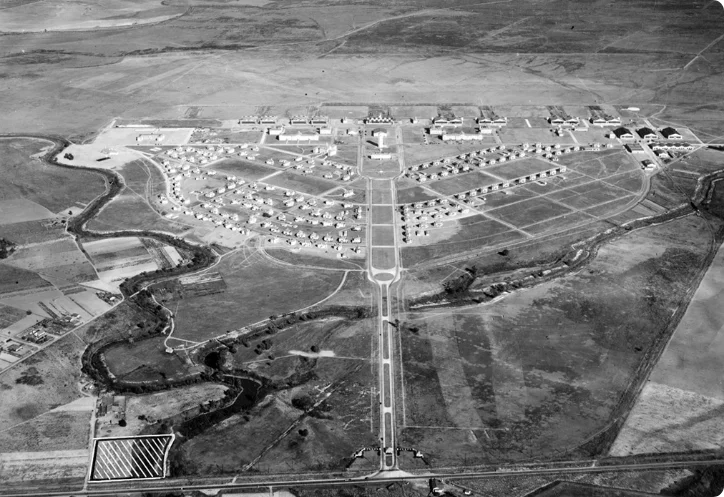
Barksdale Air Force Base has proudly served the United States for over 92 years. Emerging from the cotton fields of Northwestern Louisiana in the early 1930s, Barksdale Air Force Base has grown into a major source of revenue for the region with an economic impact that exceeds one billion dollars.
Headquartered at Barksdale Air Force Base, Air Force Global Strike Command is the single institutional command in the US Air Force providing nuclear and conventional long-range strike capabilities for deterrence, assurance, competition ops, and combat. It is the Air Force Service Component to US Strategic Command (USSTRATCOM), with two subordinate Numbered Air Forces – 20th Air Force (ICBMs) and the Mighty 8th Air Force (bombers and Command and Control aircraft). General Stephen “SL” Davis currently serves as its Commander.
AFGSC was established to reinvigorate the U.S. Air Force’s strategic deterrence and nuclear ops missions. It operates two-thirds of the nation’s nuclear arsenal. The command was formally activated on 7 August 2009 at Barksdale Air Force Base, Louisiana. The command assumed responsibility for nuclear-capable assets from Air Force Space Command on 1 December 2009 and from Air Combat Command on 1 February 2010.
AFGSC’s mission is to “develop and provide combat-ready forces for nuclear deterrence and global strike operations—safe, secure, effective—to support the President of the United States and combatant commanders.” As the Air Force component of United States Strategic Command (USSTRATCOM), AFGSC maintains a worldwide area of responsibility.
Today, AFGSC is composed of more than 31,000 personnel, assigned to nine wings, two geographically separated squadrons, and one detachment, with forces deployed globally.
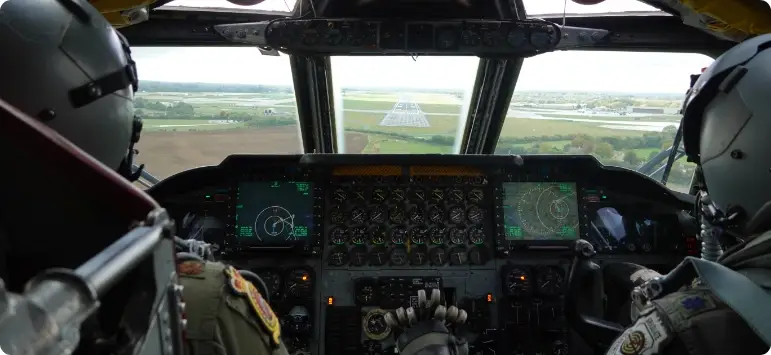
Headquartered at Barksdale Air Force Base, 8th Air Force serves as a total-force, war-fighting headquarters, employing decisive global air power for US Strategic Command. The 8AF team operates and maintains the air power at the heart of America’s heavy bombing force (B-1 Lancer, B-2 Spirit, B-52 Stratofortress) as well as the E-4B National Air Operations Center (NAOC).
Bomber Task Force missions send clear signals of U.S. military capability and resolve. This serves as a deterrent to potential adversaries, reinforcing the message that the U.S. is prepared to respond to aggression. Joint exercises and deployments with allied nations enhance interoperability and build trust. These activities showcase U.S. commitment to collective defense, reassuring partners of support in the face of common threats. Bomber flyovers in strategic regions demonstrate U.S. military reach and capability. Such actions communicate to both allies and competitors the readiness to project power and respond to crises. BTFs can be rapidly deployed to address emerging threats, allowing for swift responses that communicate U.S. intentions and capabilities to both friends and foes. Participation in multinational exercises or humanitarian missions can foster better relationships with non-aligned nations, enhancing U.S. influence and promoting stability in various regions. BTFs also support broader information campaigns by shaping perceptions of U.S. power and reliability based on physical activities that align with strategic narratives. Collaborating with partner nations to develop their own capabilities to be employed in conjunction with bomber task force flights and deployments fosters deeper military ties and ensures a unified approach to regional security challenges. In short, Bomber Task Forces play a vital role in shaping the strategic influence landscape, promoting U.S. interests, and enhancing global stability. Air Force Global Strike Command’s bomber force “non-kinetic” capabilities are less visible to audiences in the United States, but they are highly valued by Combatant Commanders and U.S. international partners.
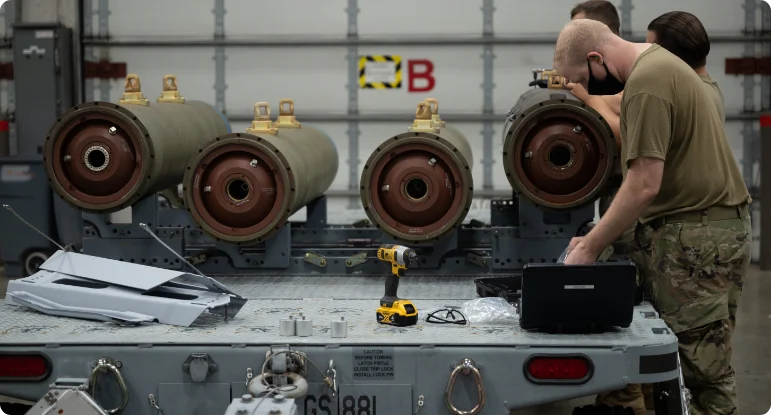
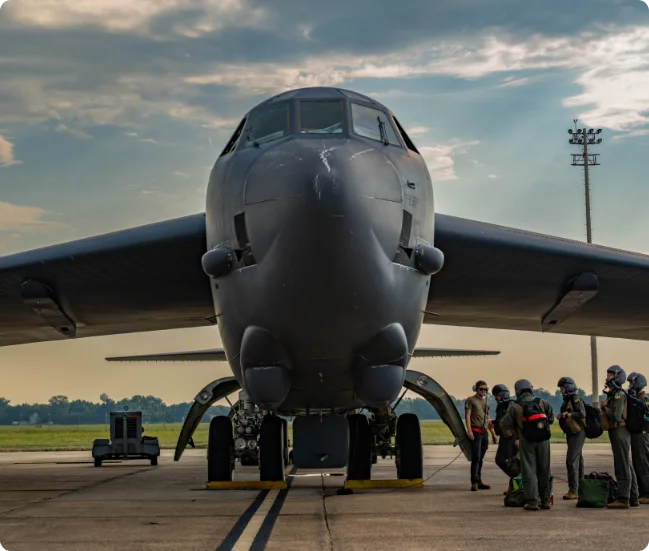
The host unit of Barksdale Air Force Base is the historic 2nd Bomb Wing, the largest B-52 Stratofortress bomber unit in the United States Air Force. The 2nd Bomb Wing provides flexible and responsive combat capability projected on a global scale, autonomously or in concert with other forces. This wing flew the longest bombing mission in the history of military aviation when seven B-52s flew a 35-hour mission to Iraq and launched the first conventional cruise missiles. The 2nd Bomb Wing delivered one-fourth of all US Air Force bombs during Desert Storm, and was responsible for missile strikes against surface-to-air missiles and air defense radars.
The historic 307th Bomb Wing – the only B-52 unit in the United States Air Force Reserves – and a host of associate and tenant units are located on the airbase contributing to the over 9,000 military, civilian, and contractor employees working on the base.
On July 2, 1926, the United States Congress passed the Air Corps Act, which expanded the number of flying units and personnel. At the time, the existing 3d Attack Group was stationed at an airfield at Fort Crockett on Galveston Island, Texas. However, it soon became clear that this facility was too limited to support the planned expansion of the group into a wing-sized organization. As a result, efforts began to identify a more suitable location for a new airfield.
Shreveport created a committee to explore possibilities that the new airfield site could be located locally and after negotiations with the War Department in Washington, D.C., the City of Shreveport made a bid – along with eight other municipalities – to host a new military airfield as the home station for the 3d Attack Group. The ideal site for this new airfield would consist of 1,000 acres for the built-up area of buildings, thousands of acres for a gunnery and bombing range, and the capacity to expand so to accommodate future heavier and faster military aircraft.
After a visit to Shreveport by U.S. Army aviators in 1927, the area received a favorable report. As a result, the list of potential sites for a new airfield was narrowed to three finalists: Shreveport; Fort Worth, Texas; and Montgomery, Alabama. By March 1928, the U.S. Army had completed ground and aerial surveys of Shreveport’s proposed military site, located near Cross Lake—the city’s primary freshwater reservoir. However, the Army ultimately rejected the site, citing its hilly, wooded terrain and the high cost of leveling the land to meet airfield requirements.
In response, Shreveport quickly identified and offered an alternative: a flat, agricultural tract that Army aviators soon visited and found suitable. Although this new location met all Air Corps requirements, it was not in Caddo Parish but rather in an unincorporated area of Bossier Parish, across the Red River from Shreveport.
With the support of Louisiana Governor Huey P. Long and the State Legislature, legal approval was granted in early November 1928, for the City of Shreveport to acquire and donate the land to the federal government. On November 14, 1928, the Assistant Secretary of War and the Chief of Staff of the Army Air Corps visited the Bossier site. Just weeks later, on December 5, 1928, the War Department formally announced Shreveport as the new home of the 3d Attack Group.
On 14 May 1929, the residents of Shreveport approved two bond issues. The first issue was for $1.5 million to buy the land in Bossier Parish that was composed of 135 separate tracts involving some 800 owners thus a challenge in clearing all titles to the land being purchased. The second bond issue for $300,000 was to build a municipal airport in Shreveport (opened in 1931, today’s Downtown Airport). Later in 1929, the Bossier Parish Police Jury approved the designated land to be expropriated. Subsequently, on 18 November 1930, the “Deed to the Barksdale Field” was signed with the title to the land for the soon-to-be new airfield formally transferred to the federal government.
In accordance with War Department policy, new airfields were to be named in honor of Army aviators who had died in the line of duty. As a result, the new base was named after Lieutenant Eugene Hoy Barksdale—a Mississippi native and World War I aviator who was killed in 1926, while testing an experimental military aircraft over Ohio.
U.S. Army policy also required that the architectural style of new airfields reflect the historic and geographic character of their local setting. Given its Louisiana location, the selected architectural style was French Colonial Revival. Additionally, a Beaux-Arts-inspired urban design was adopted for the base layout, incorporating green spaces and broad boulevards throughout the developed area.
Large-scale construction of the airfield began in January 1931, with ten major contractors from Shreveport and nineteen additional contractors from Texas, Arkansas, Tennessee, Illinois, Indiana, and Michigan participating. In 1932 alone, 123 of the 270 planned buildings were completed. The total investment in Barksdale Field—including land acquisition by the City of Shreveport—amounted to $11 million.
With nearly 22,000 acres, including gunnery and bombing ranges, Barksdale Field was declared the largest airfield in the world at the time. Although construction of all facilities was not yet complete, the base was formally opened on February 2, 1933.
The dedication of Barksdale Field on February 2, 1933, marked the realization of a community vision that began in the early 1920s—to usher the region into the aviation age. It was the result of remarkable teamwork among elected officials, civic and business leaders—many of them World War I veterans—and the citizens of Shreveport, who worked together to secure land for a military airfield.
In May 1940, Barksdale Field participated in the Louisiana Maneuvers—a massive air and ground training exercise involving approximately 320 Army Air Corps aircraft. Following the United States’ entry into World War II, Barksdale’s extensive size made it ideal for training bomber units of the United States Army Air Forces in preparation for overseas deployment.
After the war, the National Security Act of 1947 established the United States Air Force as a separate branch of the military. As a result, Barksdale Field was redesignated as Barksdale Air Force Base on January 13, 1948. It was later assigned to the Strategic Air Command on November 1, 1949.
As a Strategic Air Command (SAC) base, Barksdale Air Force Base underwent significant expansion to accommodate large aircraft operations, including both bombers and support aircraft. The base hosted a succession of long-range bombers—from the B-29 Superfortress to the first jet-powered bomber, the B-47 Stratojet, and beginning on August 14, 1958, the B-52 Stratofortress.
Barksdale became actively involved in SAC’s Alert Force operations, a key component of the nation’s nuclear deterrence strategy during the Cold War. On February 20, 1960, a permanent Alert Facility was opened on the base, supporting around-the-clock readiness operations that continued until October 26, 1991.
From the 1960s into the early 1970s, units from Barksdale Air Force Base rotated and conducted air combat operations during the Vietnam War.
On January 1, 1975, 8 AF headquarters was established at Barksdale AFB having completed its tour at Anderson AFB in Guam during the Vietnam War. In 2025, 8 AF marked its 50th anniversary at Barksdale AFB, the longest single duty station for 8AF in its history.
Decades later, on January 16–17, 1991, seven B-52 bombers from Barksdale’s 2nd Bomb Wing carried out the historic Operation Senior Surprise—the opening air combat mission of Operation Desert Storm, which marked the beginning of efforts to liberate Kuwait from Iraqi occupation. This single mission, with its multiple first-in-history achievements, continues to influence the United States Air Force’s current Bomber Task Force global operations.
On September 11, 2001, Barksdale Air Force Base played a pivotal role during the terrorist attacks on the United States. The base provided security and support for President George W. Bush after Air Force One landed at Barksdale in response to the unfolding crisis. From the Eighth Air Force’s Conference Room, President Bush delivered his first public address to the nation regarding the attacks.
In 2009, the United States Air Force established Air Force Global Strike Command (AFGSC), headquartered at Barksdale Air Force Base. This new major command was created to lead the nation’s long-range, nuclear-capable bomber and intercontinental ballistic missile forces, with a mission focused on global presence, strategic deterrence, and global strike capabilities.